MAKE YOUR MARK! International Dot Day @ Rooftop School

dot_sec

September 15th marks the anniversary of the publication of best-selling author/illustrator Peter H. Reynolds’ The Dot, a “story book for all ages.”

Author Peter Reynolds told School Library Journal. “I pinch myself, thinking that four decades ago I was being told to stop drawing in my classes and pay attention, and here we are in 2016 with a school sanctioned day to celebrate creativity.”

The Dot more than anything celebrates the power of creative teaching,” Reynolds explains. “Despite the test-centric world we live in, creative teachers know how to find those aha moments — much the same way that my 7th grade math teacher Mr. Matson ‘connected the dots’ between math and art, which changed my life.” To honor that moment, Reynolds dedicated The Dot to Mr. Matson.

Rooftop School is joining the The Dot Club fun & inviting you to read-alongdraw-along, and even sing-along!

20160908TheDotIMG_8755.jpg

To get things started, Rooftop librarian Tamra Marshall will be reading THE DOT with all K-2 classes.
dotday_connect

#DOTDAY LIVESTREAM

On Tuesday, September 13 at 10am, we’re connecting the dots via Skype and Discovery Education in the Burnett MPR. #CelebrateWithDE 

Author Peter H. Reynolds travels to the place where Dot Day began with Dot Day founder Terry Shay, a teacher at North Tama School in Traer, Iowa. Reynolds, Shay, and the students of North Tama will come together to celebrate creativity, courage, and collaboration on the 7th Annual International Dot Day. http://www.discoveryeducation.com/Events/monthly-themes/dot-day-2016.cfm 

#ArtIsAtTheCenter: DOT CENTRAL

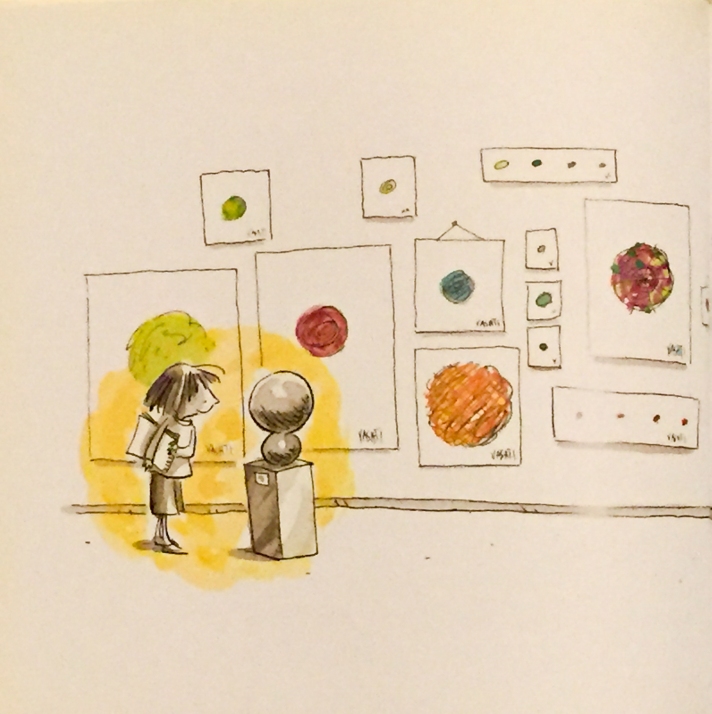
Be sure to sign your work and share your dot art on International #DotDay – Thursday, September 15, 2016! Let’s fill “Dot Central” – aka the Burnett MPR – with some fresh art!
20160908TheDotIMG_8767.jpg

THE PALE BLUE DOT & COASTAL CLEANUP DAY

Then, help us to take care of the most important dot of all — “The Pale Blue” Dot! In celebration of Coastal Cleanup Day 2016, Rooftop School will hold a Schoolyard Cleanup on Friday, September 16.

Pale Blue Dot from ORDER Productions on Vimeo.
planting-the-seeds-of-blue-in-the-rooftop-gardenjan-3-2013

The trash gathered at school will be weighed and our information will be entered into the official International Coastal Cleanup Day database.

WHAT IS COASTAL CLEANUP DAY?

Every year, on the third Saturday in September, people join together at sites all over California to take part in the State’s largest volunteer event, California Coastal Cleanup Day. In 2015, more than 68,000 volunteers removed nearly 1,143,000 pounds of trash and recyclables from California’s beaches, lakes, and waterways.

Families, friends, coworkers, scout troops, school groups, service clubs, and individuals come together to celebrate and share their appreciation of California’s fabulous coast and waterways. The event is part of the International Coastal Cleanup, organized by the Ocean Conservancy, which is the largest volunteer event on the planet!

California Coastal Cleanup Day 2016 is Saturday, September 17, 2016
 

positive-impact-blue-marbles
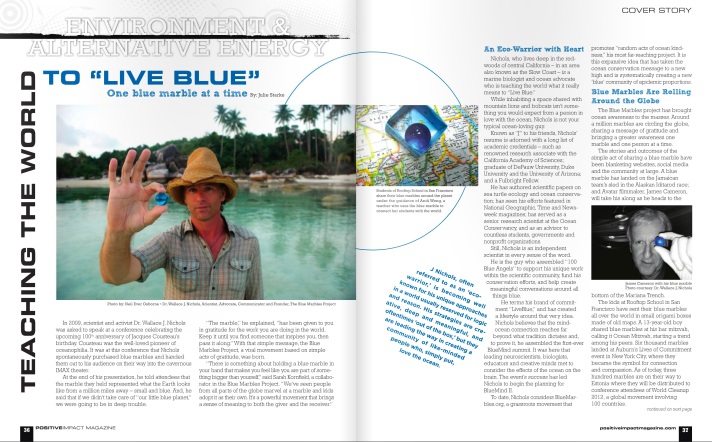
“Positive Impact” – Teaching the World To “Live Blue” https://issuu.com/positiveimpactmagazine/docs/full_pim_magazine_book_2012_digital/38?e=2938531/2717353

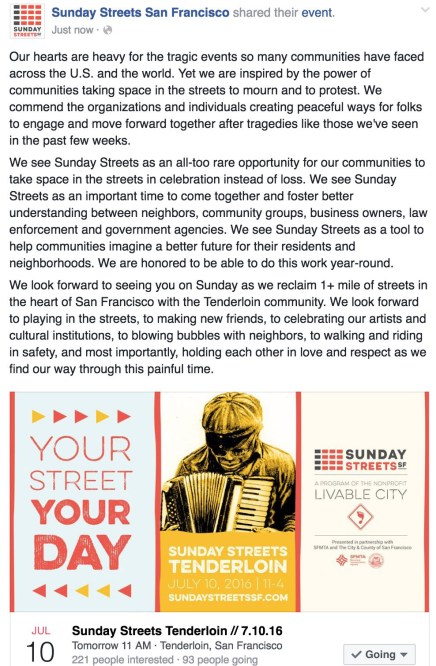
Sunday Streets in the Tenderloin: “Tender Land” with ArtsEd4All

2015 Mama Tender in the TNF

2016 Sunday Streets in the Tenderloin: 

TENDER LAND” with ArtsEd4All

Sunday, July 10, 2016, Noon – 4pm

at the Luggage Store Annex / Tenderloin National Forest

509 Ellis Street (between Hyde & Leavenworth)


Luggage Store Co-Artistic Directors/Artists Darryl Smith and Laurie Lazer of the luggage store have been working to transform Cohen Alley since 1989 from a place emblazed in a health-hazardous cesspool of bodily fluids and other dumped items, non-supervised open-air chemical experiments and illicit – criminal activities — to a vibrant community commons where people of all ages can gather for public art, performance, experimental art projects. and classes and activities. In May of 2009, the land that was then called Cohen Alley was reclaimed as “The Tenderloin National Forest.”

http://www.luggagestoregallery.org


“Ode to Mama Tender” — “In 1989, Darryl Smith planted a redwood tree in the shady asphalt. Help us to write a poem as lovely as Mama Tender, the redwood that is the “heartwood” of the Tenderloin National Forest.


“A Tree Grows in Cohen Alley” – Visitors to the Tenderloin National Forest will enjoy a wide range of trees and plant life. Citizen scientists can help to document the biodiversity in the Tenderloin National Forest with iNaturalist. Share your photographs of the nature that you discover in the TNF via Facebook, Twitter, and Instagram. #TNFTenderland


“Wood U Like 2 Play” — Let’s make beautiful music together! Enjoy a wood song sing-a-long.


“Common Scents” – The sense of smell is closely linked with memory, probably more so than any of our other senses. Take a deep breath and enjoy the smell of redwood. Make a scent diffuser to bring home.


For more information about Sunday Streets:
Sunday Streets 7.10.16

Happy Lunar New Year!

Yin-Yang-5th-Grade

The terms yin and yang originated in ancient Chinese philosophy. Yin and yang mean literally the “dark side” and the “sunny side” of a hill. In Chinese and much other Eastern thought, they represent the opposites of which the world is thought to be composed: dark and light, female and male, Earth and heaven, death and birth, matter and spirit.

Yin yang drawings created by Ms. Hamilburg’s 5th graders at Rooftop School.


Cultural Exchange: Kung Fu Panda 3

With the success of the 2008 animated film Kung Fu Panda, Chinese moviegoers praised the film’s depiction of Chinese culture and careful attention to details, “from the martial arts scenes to its depiction of family expectations and how the ancients were believed to pass into the afterlife.”  Wu Jiang, president of the National Peking Opera Company, told the official New China News Agency, “The film’s protagonist is China’s national treasure and all the elements are Chinese, but why didn’t we make such a film?”

Now, eight years laterKung Fu Panda 3 is DreamWorks’ first official U.S./China co-produced film opening simultaneously in the US and China on January 29Po the kung fu-fighting panda, Oogway, Shifu, and the Furious Five return in Kung Fu Panda 3.

Thanks to the San Francisco Film Society’s Education Program, Kung Fu Panda comes to Rooftop School. On Friday, January 8th at 12:30pm, 3rd, 4th and 7th grade students will attend a special presentation with Kung Fu Panda 3’s producer Melissa Cobb and co-directors Alessandro Carloni and Jennifer Yuh Nelson (who has the distinction of being the first woman to direct a big-budget animated film for a major studio).

The film’s creative team will share how the Kung Fu Panda 3 artists researched China’s culture (architecture, food, clothing, and, of course, kung fu!) for the film. The artists were also inspired by China’s natural beauty, the country’s distinct landscapes and wildlife — including the endangered golden monkey, South China tiger, red panda, and Giant pandaWe’ll get a peek at scenes from the new movie, enjoy a drawing demonstration and Q&A with the filmmakers.

wp_kpf3_01_1920x1440

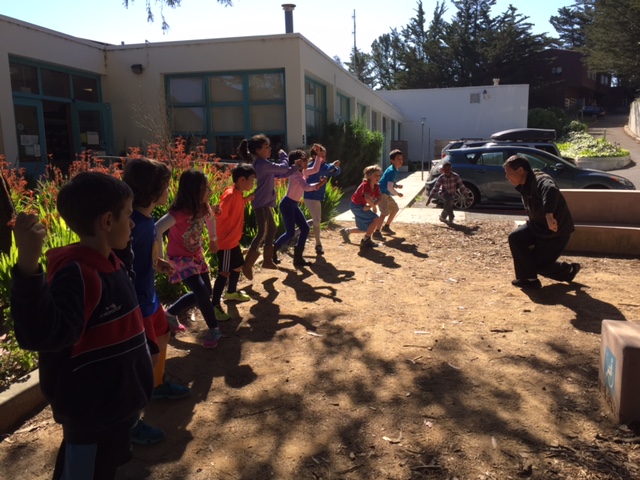
Weather permitting, the entire school is invited to come to the circle for a post-presentation performance which will include a Shaolin animal-style kung fu demonstration with special guests.

There will also be an art activity available for all classes to make their own bolang gu, a Chinese rattle drum, one of the earliest toys dating back to the Song Dynasty (960-1279). Practice playing your drum with friends and use your power to speak up for Giant Pandas.

Kung Fu Panda Art

Meet the Characters of Kung Fu Panda

Meet the Creative Team

Jennifer Yuh Nelson

Alessandro Carloni

DreamWorks Animation invited artists, photographers, designers and illustrators worldwide to create art that illustrated Po on his journey home for Kung Fu Panda 3. Inspired by Po, his friends and all the amazing places around the world, artists went straight to work and submitted over 400 stunning submissions of Po in different continents. Whether he was fighting bulls in Spain, trying on some lederhosen in Munich, riding the train in New York, or even attending a festival in India, Po popped up in almost every landmark around the world.

Five Animals Kung Fu

The foundation of the Southern Shaolin martial art systems can be attributed to these five animals – Snake, Tiger, Leopard and Crane, and the mythological Dragon.

Part of the kung fu student’s training is to emulate the spirit and the movement of these animals. They are instructed to visit the city zoo and the library to study the quintessence nature of the animal.

image1

Sifu Young Wong of the EY Lee Kung Fu School teaches third graders some animal style kung fu.

Panda Resources & Links:

Explore.org: Happiness Village – Pandas in Gengda, China

Chengdu Research Base of Giant Panda Breeding: Panda Live

National Zoo: Giant Panda Cam


Nature Works Everywhere: Virtual Field Trip to China’s Great Forests

Join expert scientist Yue Wang, a conservation planning officer for The Nature Conservancy, on a virtual field trip across the world to two stunning provinces in China—Sichuan and Yunnan. Explore majestic forests, towering mountains, and other iconic landscapes. While examining the role these vital natural areas play in the carbon cycle and climate change, as well as the benefits of reforestation, we will learn about the magnificent creatures who call these habitats home: giant pandas, golden snub-nosed monkeys, and the elusive and odd-looking takin.


World Wildlife Fund: What is the story behind the panda logo of WWF?

panda_logo_history_large_350984

Aware of the need for a strong symbol that would overcome all language barriers, founders of the World Wildlife Fund chose the Giant Panda. “We wanted an animal that is beautiful, is endangered, and one loved by many people in the world for its appealing qualities.” The black-and-white panda has since come to stand as a symbol for the conservation movement as a whole.

NEAT: New Experiments in Art and Technology

“Each wave of art and technology starts with a real or imagined discovery: land, gold, atomic elements, hallucinogens, circuits, algorithms.  As Timothy Leary allegedly observed: “California is the end of the genetic runway.” The Northern California / Bay Area Art and Technology counterculture paves that runway with a true love of science and engineering, a deep resistance to authority, and an undaunted belief in Power to the People. The Bay Area is quick to forgive and embrace projects that don’t go the way they were intended. This ecosystem has evolved to explore, experiment, and to express ideas that could not be expressed before.” 

— From “Art Technology and Bay Area CounterCulture” by Ken Goldberg

This slideshow requires JavaScript.

NEAT: New Experiments in Art and Technology at the Contemporary Jewish Museum features nine Bay Area artists, representing three generations of practitioners. Each artist has been commissioned to make a new piece, or update an older artwork, that demonstrates how digital programming is a central, yet just the latest, tool for artist creativity.


GUIDING QUESTIONS

  • How is the work of an artist similar to the work of a scientist?
  • What are the similarities between artistic and scientific processes?
  • What are the similarities between the materials used by artists and scientists?
  • What role does art play in our lives?

NEAT RESOURCES

CJM’s NEAT Online Exhibition Catalog features photos of the works of art and video interviews with the artists, as well as timeline & essays from curator Renny Pritikin, and digital artists Ken Goldberg and Jenny Odell.

NEAT offers playful ways to examine creative applications of STEM concepts for a true STEAM approach. The NEAT Educator Resource Guide offers a visual analysis of selected artworks and links the works to broader concepts in programming, engineering, science, and mathematics. This curriculum provides both arts-based resources as well as STEM-inspired activities to explore the technologies used by the artists in NEAT. Each module in this resource is grounded in the principles of the relevant Next Generation Science Standards and connects to scientific method-inspired processes of observing, hypothesizing, experimenting, and interpreting.

On the field trips, students played with Light Play, an activity created by the Exploratorium’s Tinkering Studio that encourages exploration of light, shadow, and motion using a variety of simple materials and light sources. Beginning with gently guided explorations of shadows, single and multiple light sources, three-dimensional objects and translucency, participants gain the proficiency and “light vocabulary” to express their ideas, and their creativity is sparked. They work toward building kinetic light and shadow vignettes, and eventually combine them into a collaborative installation.

This slideshow requires JavaScript.

  • The Tinkering Studio’s Light Play lets you explore light, shadow, and motion using a variety of simple materials and light sources. Beginning with gently guided explorations of shadows, single and multiple light sources, three-dimensional objects and translucency, participants gain the proficiency and “light vocabulary” to express their ideas, and their creativity is sparked. http://tinkering.exploratorium.edu/2015/10/02/light-play-fablearn
  • Scratch A project of the Lifelong Kindergarten Group at the MIT Media Lab. It is provided free of charge. https://scratch.mit.edu/

ONE SCHOOL, ONE BOOK – ON A BEAM OF LIGHT

On_A_Beam_of_Light

Rooftop Librarian Tamra Marshall invites classrooms to participate in a One School, One Book event in conjunction with the NEAT exhibit. Tamra has selected a picture book, On a Beam of Light: A Story of Albert Einstein by Jennifer Berne and Vladimir Radunsky, which makes wonderful connections to the spirit of this exhibit. Teachers will receive a copy to be added to each classroom library and determine how to connect it to their grade level or content area. A goal will be to forge a Burnett – Mayeda connection as teachers across the grades to reach out to each other and share how they used the book.

Lib Guide http://sfusd.libguides.com/profile.php?uid=94182

  • EarthKAM is a NASA educational outreach program that enables students, teachers, and the public to learn about Earth from the unique perspective of space. During Sally Ride EarthKAM missions (periods when the Sally Ride EarthKAM camera is operational), middle school students around the world request images of specific locations on Earth. View photos taken from the International Space Station by Rooftop students from “Mission 50” (November 10-13, 2015).
  • Your Star – A temporary public artwork by artist Olafur Eliasson that celebrates knowledge, dreams and light. The bright new star will shine in the sky above Stockholm to mark Nobel Week (December 6-12). The website features six videos which follow the emergence of an idea and its journey towards becoming an artwork. The site also offers visitors the opportunity to make their own stars in the virtual night sky. http://www.olafureliasson.net/yourstar/
  • Illuminate San Francisco – Any night of the year, you can embrace the power of light and enjoy exploring the city’s many neighborhoods with luminous public artworks by some of the world’s most notable light artists – including Jim Campbell, Ned Kahn, James Turrell and Leo Villareal. Best yet, these brilliant light art installations are accessible by public transport and free for all. http://illuminatesf.com/


E.A.T. –Experiments in Art and Technology (1967)

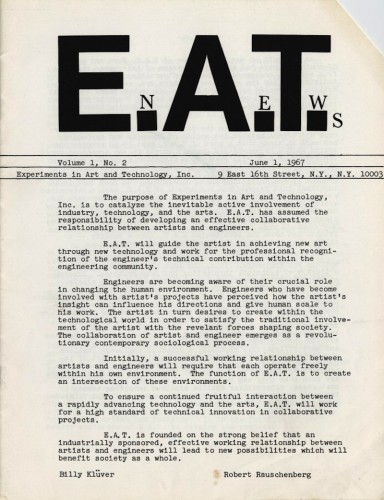
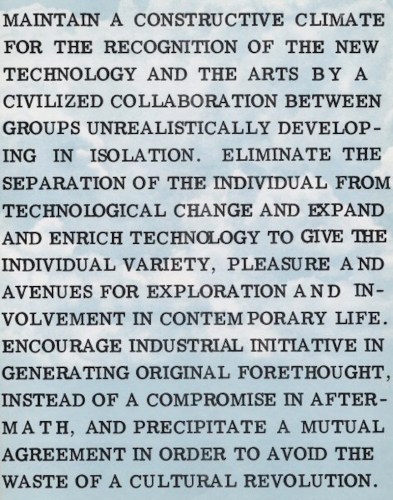
The 1960s program Experiments in Art and Technology (E.A.T.) was a turning point in art’s relationship with science as artists and scientists worked together on new, creative projects. In 1967, Experiments in Art and Technology (E.A.T.) was officially launched by Billy Klüver and Robert Rauschenberg after having collaborated for many previous projects, notably the festival «9 Evenings: Theater and Engineeering. 

A Brief History and Summary of Major Projects 1966 – 1998  http://www.vasulka.org/archive/Writings/EAT.pdf

  • E.A.T. – Children and Communication (1971)

For Children and Communication, Robert Whitman designed environments where the children could freely access facsimile machines, electro-writers, telex machines and telephones. For four months, more than 500 children typed or hand-wrote messages, sent pictures and talked to children at another location, children from other areas of the city they would not normally meet. http://www.mediaartnet.org/works/children-and-communication/

  • Leap Before You Look: Black Mountain College 1933–1957 bit.ly/1KAs8NS

Crossroads and Cosmopolitanism at Black Mountain College chronicles the stories of fifteen students & teachers, including NEAT’s Robert Rauschenberg & San Francisco artist Ruth Asawa. http://mappingbmc.org/

  • Ruth Asawa: “Transforming the Ordinary” at Rooftop School

In the Spring of 2004, Rooftop School focused on the art of artist and arts advocate Ruth Asawa (1926-2013). https://youtu.be/4z-Amx8dcFM

EAT News - Volume 1, 1967EAT Statement of Purpose, 1967

Cantastoria Cornucopia

Following up on the October 8th Bread & Puppet cantastoria workshop for San Francisco Unified School District, Clare Dolan kindly shares the following examples of International and American Cantastoria. Clare is the co-creator and festival curator for Banners & Cranks, an annual festival of cantastoria performance by artists and musicians from all over the United States, and the Chief Operating Philosopher of the fascinating Museum of Every Day Life in Glover, Vermont, whose goal is to explore, analyze and celebrate everyday life objects.

Contemporary International Cantastoria

Jhadpur Cantastoria

Sicilian Catastoria

Papel Machete

French Cantastoria

Documentary about the Belgali scroll painting singers

Bengali performers performing

Contemporary American Cantastoria

Takes After His Father – by Dave Buchen

As I Walked Out One Evening – by More of Everything Theater Company

Old Reliable Amusements – by The Dolly Wagglers

Bread & Puppet’s The Foot (narrated by Andrea diFrancesco)

Where’s My f-ing Bailout — by Clare Dolan/Museum of Every Day Life

St James Infirmary – by Blair Thomas

Happy Narouz – by Great Small Works

Hurricaine Manifesto – Clare Dolan/Museum of Every Day Life

Answers to 4 Questions – Clare Dolan/Museum of Every Day Life

Ballad of Jacob Apfelboek – Clare Dolan/Museum of Every Day Life

Mack the Knife – Meredith Miller

SFUSD / Bread and Puppet Theater: A Cantastoria Workshop at the Curran

“Our glorious civilization glorifies itself with what it calls high art. Puppeteers have no soul-searching trouble in that respect. What we produce has no ambition to be high art. Low art is what we make and what we want. Not the Fine Arts—the Coarse Arts are what we use.”

— Peter Schumann, lecture to art student at SUNY Purchase, 1987

IMG_5937


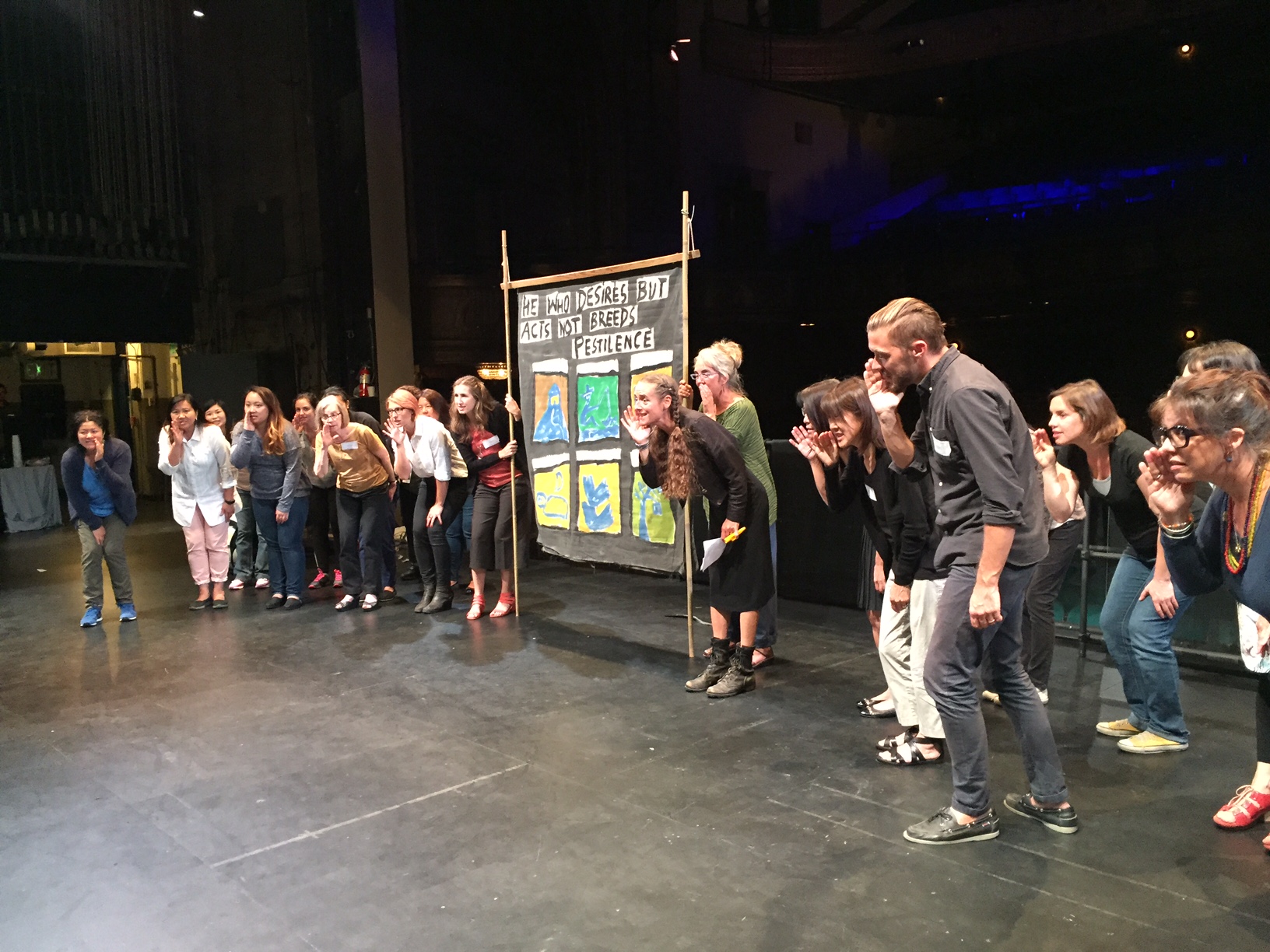
On Thursday, October 8, 2015, from 4pm-6pm, San Francisco Unified School District Visual and Performing Arts Department Elementary/K-8 and Secondary Arts Coordinators gathered on the stage of the Curran Theater for a Cantastoria Workshop, led by Clare Dolan and members of the 2015 West Coast touring company of Bread and Puppet Theater.

The workshop participants were welcomed to The Curran: Under Construction by Carole Shorenstein Hays, Greg Backstrom and Brian Farley. Andi Wong of Rooftop Alternative School spoke on the theme of “Inspiration,” having received a healthy dose of wonder at the Bread and Puppet Farm in Glover, Vermont, in advance of the troupe’s Bay Area visit. SFUSD Arts Education Master Plan Implementation Manager Antigone Trimis drew connections to student learning, school site culture and climate. After an introductory slide show about Bread and Puppet Theater and cantastoria by Clare Dolan, the art coordinators gathered on the stage of the historic theater to learn by doing.

Cantastoria is one of the oldest performance forms known to humans, originating in India more than two thousand years ago. It typically involved one or two performers, often performing on the street, and a multi-image scroll or a series of paintings mounted together at the top. Bread & Puppet Theater’s version of Cantastoria is usually performed with a narrator who points at the pictures and one or two “choruses” who respond to the narration. The subject of the cantastoria can be anything and directed to any age audience.

Clare Dolan and Bread and Puppet performers Esteli Kitchen, Joshua Krugman,Kali Therrien, Luis Gabriel Sanabria, MJ Hicks, and Tom Cunningham guided participants through the creation, narration and choral performing of this ancient art form.

Bread and Puppet Theater & Cantastoria / Common Core Connections

• Ensemble • Risk • Improvisation • Visual Literacy • Inquiry (necessary for the ensemble to create the piece, will bring added empathy for subject being presented) • Oral Presentation • Close Reading (visual and physical movement, etc, what is the ‘text’ in this work? For the performer? For the audience?) • Student Voice (primary in this work)

For additional information about Bread and Puppet Theater and Cantastoria:

• Bread and Puppet Theater http://breadandpuppet.org/

• The Internet Archive “Bread and Puppet Archive” is preserving 150 hours of video of circuses, pageants, passion plays, 250 puppeteers, and making it available to the public. https://archive.org/details/breadandpuppet

• “Ah! The Hopeful Pageantry of Bread and Puppet” by Dee Dee Halleck and Tamar Schumann https://archive.org/details/ah_the_hopeful_pageantry_of_bread_and_puppet

• “About Sung Paintings or Cantastoria” by Clare Dolan, Museum of Every Day Life http://museumofeverydaylife.org/wp-content/uploads/About-Sung-Paintings-or-Cantastoria3.pdf

• Clare Dolan answers the question: What is cantastoria?
https://youtu.be/_kEVoCsgsS0

• Clare Dolan & Bread and Puppet Theater perform “The Sky” (2007). https://youtu.be/NcmvHzeLwvY

• Banners and Cranks: a traveling cantastoria & cranky festival http://bannersandcranks.org/

Play and Partnership: Celebrating the 2015 International Day of Peace

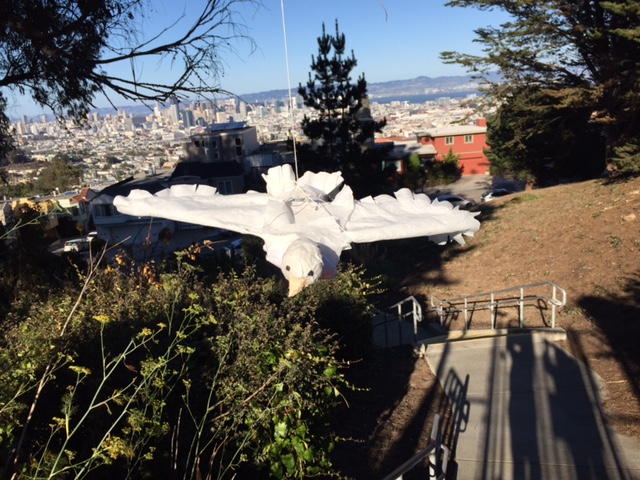
Play and partnership can help us to imagine and create more peaceful world. On Monday, September 21, the students and teachers at Rooftop School will gather for a moment of peace at Morning Circle. We will fly the peace dove puppets made by third and fourth graders to mark the day with Roots and Shoots, Jane Goodall’s youth-focused organization.

“Every individual matters. Every individual has a role to play. Every individual makes a difference.” — Jane Goodall, With Love (1999)

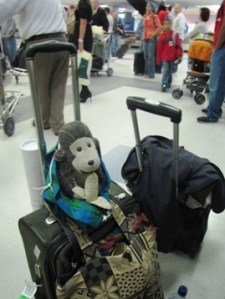
When Dr. Jane Goodall was just over one year old, her father gave her a toy chimpanzee named Jubilee, in honor of a baby chimpanzee born at the London Zoo. Friends warn her parents that such a gift will cause nightmares for a child. However, Jane loves the toy carries it with her everywhere. Today, Jane travels with a stuffed monkey named Mr. H, who has been touched by over 2.5 million people from around the world and visited more than 60 countries with Jane.

Understanding the power of children in the conservation movement, Jane Goodall spoke directly to youth in this 2008 video interview.

As a United Nations Messenger of Peace, Dr. Jane makes it a priority each and every year to observe and celebrate the annual International Day of Peace on September 21. One of the ways that students can celebrate the day is by building a Peace Dove Puppet.

IMG_4973

Instructions for small and giant puppets can be found on the Roots and Shoots website.

This slideshow requires JavaScript.

Dr. Goodall encourages individuals around the globe to participate in the United Nations International Day of Peace which is celebrated on September 21 each year. This year, an especially auspicious one with the UN’s celebration its 70th anniversary, will have the theme of, “Partnerships for Peace – Dignity for All.” Click here to learn more about Dr. Goodall’s role as a UN Messenger of Peace and how you can participate in celebrating in the annual Day of Peace.

The Fine Print

“Before printing was discovered, a century was equal to a thousand years.” 

— HENRY DAVID THOREAU

The Old & The New - 05

In with the old and out with the new. What a difference a century makes for the art of printing!

Rooftop Art Coordinator Cheryl Ball has an appreciation for the art of the book. From papermaking to bookbinding, the art of making a fine book by hand is a slow process that requires much patience. A time warp tour with Cheryl opened our eyes to the past and future of printing.

The evening began with a visit to a small custom letterpress, bookbinding and papermaking studio, filled with antique printing presses and beautiful handmade treasures by papermaker, letterpress printer and book artist Rhiannon Alpers of Gazelle & Goat.

This slideshow requires JavaScript.

Then, off to marvel at 3D printing and automated machines at the San Francisco Museum of Arts and Crafts.

The Old & The New - 26

“Data Clay: Digital Strategies For Parsing The Earth” showcased experiments in ceramics, coupled with digital technology, while Chris Eckert’s “Mechanical Parables” hummed, whirred and delighted.

This slideshow requires JavaScript.

A Poem Lovely as a Tree

The Family Tree

Visual artist FLO OY WONG loves poetry. At the age of 75, Flo set her sights on becoming a poet, and she has worked diligently to master the art of writing poetry. To quote the National Center for Creative Aging, “There is no doubt Mrs. Wong will carry out her plan to keep working as long as she is able to do so.”  A vibrant elder, Flo dives into new challenges with whole-hearted gusto.

Last November 2013, the students of Rooftop School received a very special present from Flo — their own art show. Rooftop Art’s “A Slice of Life” at the Luggage Store Annex was a companion show to Flo’s 75th birthday show, “The Whole Pie.”  As a nod to Flo’s interest in poetry, visitors were invited to stroll through the Tenderloin National Forest to read poems written by Ms. Woo’s 4th graders.

This year, as Flo celebrated her 76th birthday with family in New York, Flo revealed that she was working on a new project with her granddaughter Sasha. As a visiting artist in Sasha’s classroom, Flo used visual art to help children to see the poetry in trees. At home, Flo and Sasha worked together to make a very special tree box.

We thank Flo, Sasha and Ms. Robin Farrell’s 3rd grade class at Hillside Elementary School in Hastings-on-Hudson, New York for sharing their process, their art, and their mutual love of trees.

Seeing Trees

FLO: My tree project with Sasha started when I was home in Sunnyvale.  I took pictures of these trees when I was going on daily walks.  I sent them to Sasha after she asked to see the tree trunks I was talking about.  My husband Ed knew about my tree-sharing and he began to point out trees to me.  There was one, in particular, which inspired me to write my poem, Tree Trunk.

Fast forward to mid-October when I taught a tree-drawing lesson in her 3rd grade class.  The day before the other lesson her teacher selected, Sasha gave me input. She told me she didn’t want me to repeat what I had taught in her 2nd grade class.

Flo suggested that the class learn how to draw trees, a spontaneous decision that met with Sasha’s approval. Flo discussed trees, focusing mainly on color of trunks.  After demonstrating how to draw a tree Flo told the 3rd graders they could draw either realistic or fantasy trees.  The criteria?  They had to fill their paper top to bottom, side to side. She introduced them to non-dominant hand drawing and requested one tree be drawn with their non-dominant hand.  Then, the students needed to create interest in the negative spaces. They also wrote tree stories.  One boy, a ballet dancer at the Met, drew a dancing tree.  A girl created one with swirling energy in the trees and the surrounding environment. The hour lesson turned the students into vibrant and energetic tree detectives.

When the class was through, Sasha conducted an exit interview with her grandmother about the lesson. Sasha’s critique: She would have cut back the drawing time so more artists could share their work with her grandmother.

FLO: What I liked so much about the lesson was this – I integrated my love of poetry and art for this eye-opening, heartwarming classroom experience. In the evening at home Sasha and I memorized Joyce Kilmer’s poem.  We recited it around the dinner table.

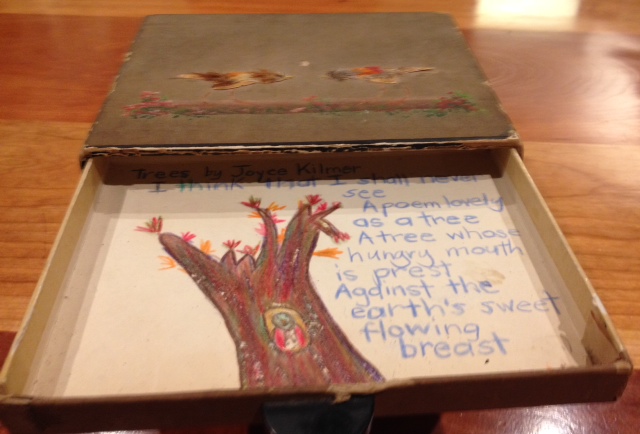
Sasha memorizes Joyce Kilmer’s poem Trees, just as her grandmother had done when she was a young student at Lincoln School in Oakland Chinatown. Flo learned and recited Trees for a tree planting ceremony. She recalled, “We buried a time box with the tree. I wonder if our box has been uncovered. I have remembered Trees for over 60 years.” Sasha and Flo also listened to Louis Armstrong and Paul Robeson sing their musical settings of Kilmer’s poem.

This slideshow requires JavaScript.

Trees drawn by Ms. Robin Farrell’s 3rd grade class at Hillside Elementary School (Art by Andreas, Andrei, Aynsley, Bianca, Bruno, Clara, Dominick, Erin, Graham, Hamilton, Joshua, Leo, Luke, Max, Mia, Michaela, Nathaniel, Paul, Salett, Sasha, Yogev & Zev)

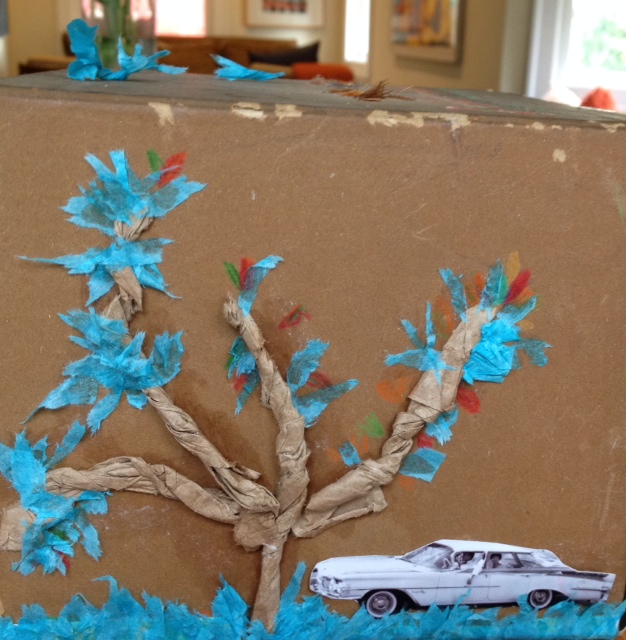
Flo and Sasha’s TREE BOX

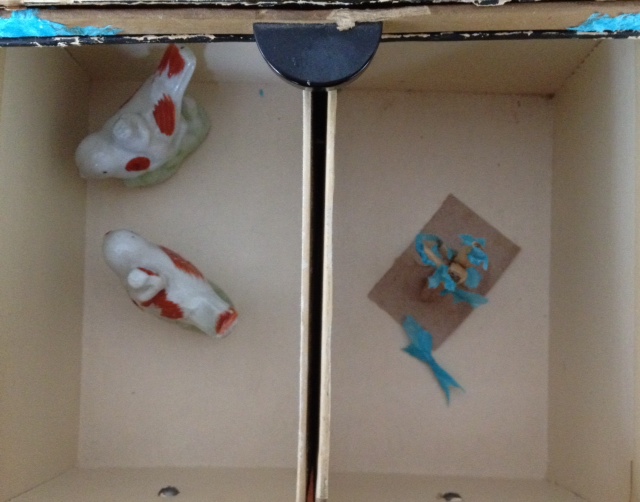
When Sasha and Flo find a 1930s box at the local antique store, they decided to make a box tree art project. Sasha includes Joyce Kilmer’s poem (partial) and her Paw Paw’s poem.  Flo adds some color atop of the colored pencils Sasha used to render the tree.

photo 2

photo 1

photo 1.3

Sasha includes two blue porcelain miniature birds that she has purchased from the antique store.

photo (2)

photo 1.1

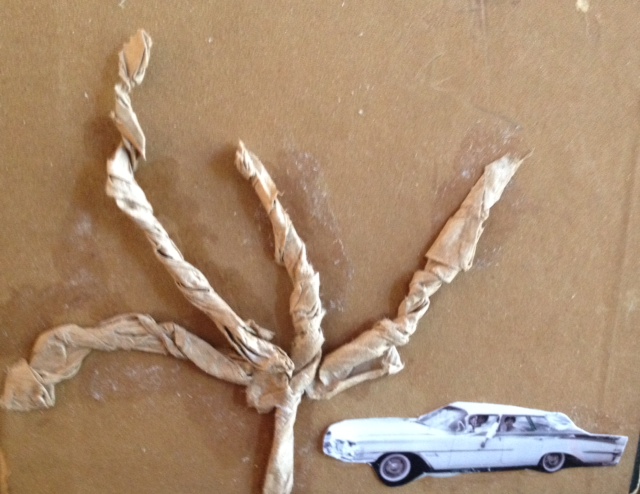
Sasha makes a tree out of a paper bag fragment to add to the tree box.

photo (3)

As a surprise, Flo adds a bird to the lower right front of the box, while Sasha is away at school.

When the box is finished, grandmother and granddaughter take some time to reflect on the process of making The Tree Box together.  Flo and Sasha use Flo’s iPhone to record their shared memory of three and a half weeks of bonding and intergenerational learning.