The Human Rube Goldberg Machine

In 2009, the Rooftop teachers reported back to school and went right back to the business of play with our Art Is… Innovation study.  In this team-building exercise, the teachers worked together to make one big human Rube Goldberg Machine.  The simple task of moving a ball through the machine was completed with great panache, as each teacher came up with their own unique way to pass a ball to the next person.  The goal was to pass 40 balls safely through the machine, without dropping any.

Innovative solutions are often possible when problems are tackled from a different perspective, and new insights are drawn.  When the global design firm IDEO comes up with new ideas in order to solve a problem, they often get inspiration from analogous situations. They may look at the team effort of a racing pit crew and apply their observations and insights to designing an environment for an operating room in a hospital.

Link to IDEO’s Design Thinking Toolkit for Educators

After completing the activity, the Rooftop teachers talked about the challenges that they encountered, and the different ways that they solved the problems.  Sometimes, an artistic experience can help people look at everyday life from a different perspective.  The group found the activity to be a good metaphor for the student educational experience at Rooftop.  Teachers must work together in synchronicity to ensure that the children travel through their time at school.  The children are touched by many hands as they go through their 9 years at Rooftop, and the members of the school team do not work in isolation.  Education is a team effort.
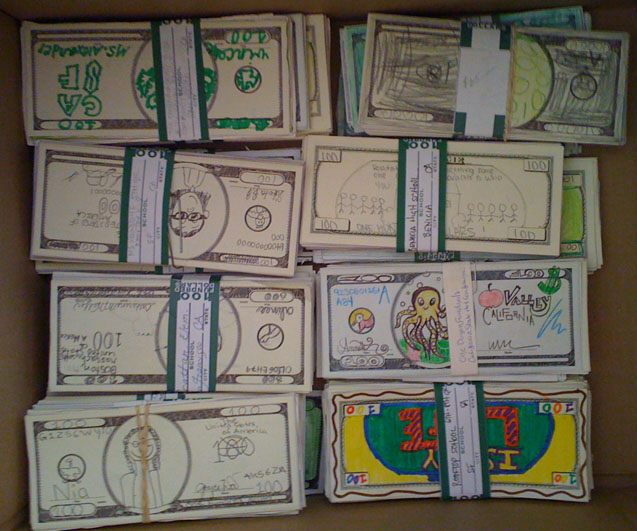
The Fundred Project

Artist Mel Chin’s The Fundred Dollar Bill Project invites children to create their own Fundred dollar bill to symbolically raise $300,000,000, the estimated cost to treat New Orleans soil to create a lead-safe New Orleans. In New Orleans alone 86,000 properties are estimated to have unsafe levels of lead in the soil. At least 30% of the inner city childhood population is affected from lead-poisoning. Operation Paydirt provides the science to transform lead so that it is no longer harmful and a citywide implementation strategy with the potential of creating a model for all cities facing a similar threat.  http://fundred.org/

You are invited to contribute your own original Fundred to the project.  Start by downloading the Fundred template, and get creative!  http://fundred.org/get-involved/

Image

Preparing for the Second Line

The Second Line parade is a New Orleans tradition that arose out of the two parts of a jazz funeral. The second line is a celebration of the life of the deceased, typically held by Social (Aide) & Pleasure Club of the neighborhood. Once a funeral service was over, a procession would travel from the church to the cemetery.  Led by a “Grand Marshal,” a brass band would play slow sad music representing the struggles, the hardships, the ups and downs of life. On the way back after the burial, the music would become more joyful. A Main Line is the “main section or the members of the actual club, that has the permit to parade. The “second line” refers to the group of people following the “main line.”

In the “Crescent City,” there are dozens of different second line parades put on throughout the year, held in neighborhoods all across the city. Each second parade has its own style and character, but there are the basics: a brass band, jubilant dancing in the street and people all decked out in colorful attire: sashes, hats and bonnets, parasols and banners.

“Oh Lord, I want to be in that number when the Saints go marching in…”


The Mask, The Umbrella  & The Song

Ms. Sugawara’s 7th graders made masks featuring a symbol designed by each student to represent their family’s cultural heritage.  The teachers decorated second line umbrellas for their classrooms. Louis Armstrong recorded “When the Saints Go Marching In” in 1938, and the song has remained a tried and true staple of American Music since then.  There are close to 1,000 different recordings of the song by artists as varied as Bruce Springsteen, Ray Charles, The Preservation Hall Jazz Band, James Brown, and even the Beatles, whose version was on the “B” side of the their first commercial release in 1961.  But it’s Satchmo’s version that people turn to capture that familiar New Orleans Spirit.


Camera-less Animation

Rooftop Arts Coordinator Amy Balsbaugh worked with Mr. Roger’s 4th grade classroom to create “Ku-Ka-Illuminoku,” a stop-motion animated film using celluloid film strips, thumbtacks, Sharpie markers, and an old-school projector.

This camera-less technique was the perfect way to illuminate students’ interest in analog and digital film projects. As you’ll hear in Amy’s “In the Classroom” interview with KQED, there were a lot of “Oohs and aahs.”


Folding an Origami Butterfly

Teaching Artist Lilli Lanier demonstrates how to fold an origami butterfly. Rooftop’s 6th grade students collaborated to make hundreds of yellow, gray, and black origami butterflies that were used to create a silhouette portrait of Puccini’s Madama Butterfly.  6th graders learned about the characters of the opera — Cio-Cio-San, Pinkerton, Sharpless, Goro, Suzuki and Trouble — in advance of their invitation to attend the final dress rehearsal of San Francisco Opera’s 2010 production of the operatic classic.

Students learned about the Japanese art of Origami (from ori meaning “folding”, and kami meaning “paper”).

Origami is the traditional Japanese folk art of paper folding, which started in the 17th century AD and was popularized in the mid-1900s. It has since then evolved into a modern art form. .

Link to San Francisco Opera’s Education Program’s classroom materials for Giacomo Puccini’s Madama Butterfly

Link to Origami Club website, featuring lots of simple origami folds, unit folds and printable origami paper designs.

The Blue Marble Project

Rooftop Alternative K-8 School is traveling all over our Wonderful World with a little help from our friends, families and Dr. Wallace J. Nichols’ Blue Marble Projecthttp://www.bluemarbles.org

Help us to make the world a little smaller, as we teach our students how to help our Ocean Planet.

Student in the computer lab are learning about geography, mapping, ocean conservation and more, through The Blue Marble Project.  Our friends are helping by sharing their adventures through photographs and correspondence.

When you get your Blue Marble, you’ll know what to do!  Think about what the ocean means to you, and what you can do to live like you love the ocean.  Share your thoughts and adventures with your friends at Rooftop.  When you are ready, pass your Blue Marble on to someone new, with the instructions that they should do the same.

Storytelling & Collage

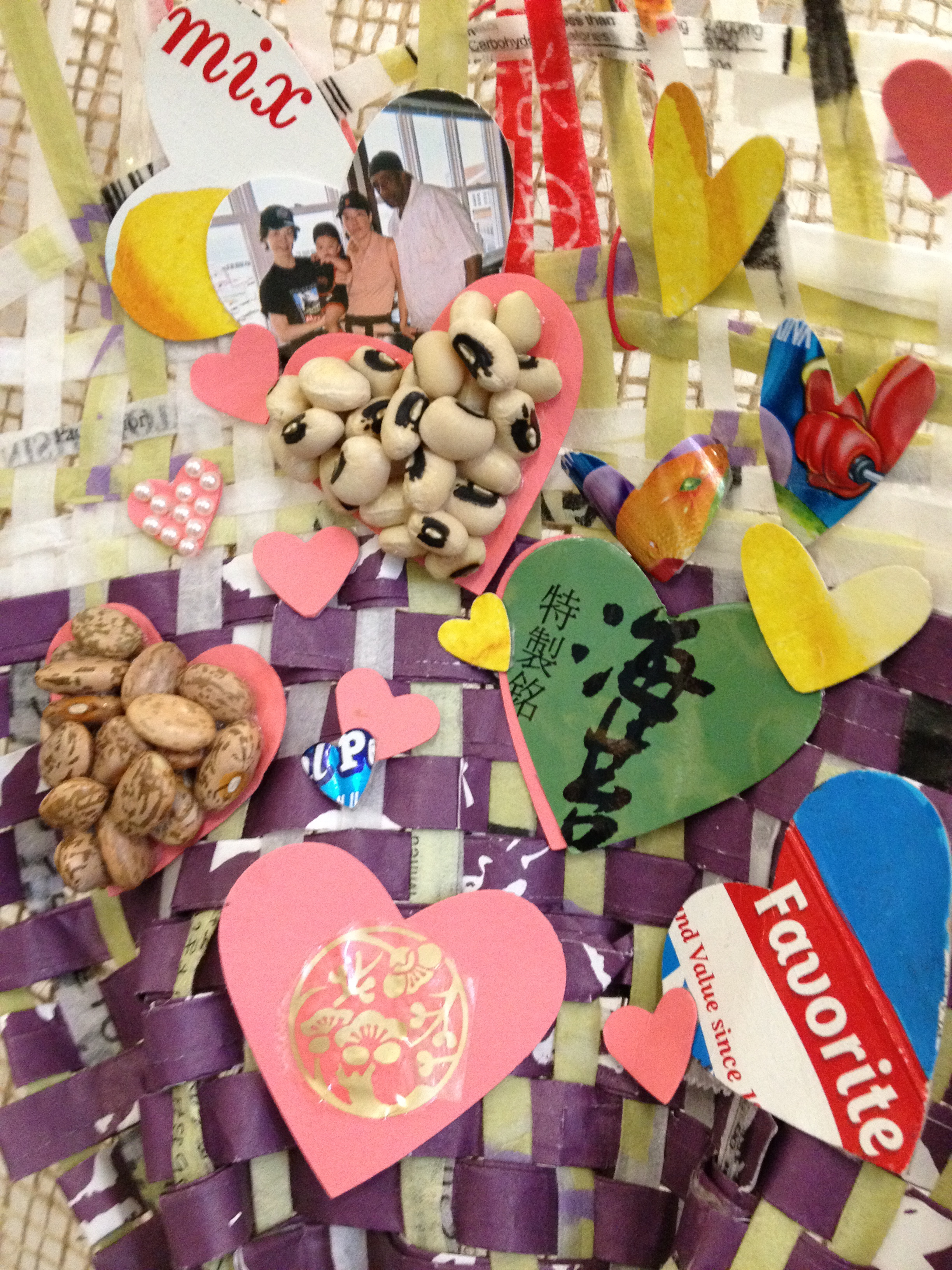
“A Moveable Feast” is a visual art lesson created for our 2011 Art Is… Expression study, in response to the art of Flo Oy Wong, visual storyteller.  Rooftop families were invited to work together to eate a mixed-media collage using memories and stories about food as the source of inspiration.

Artistic expression gives us a way to capture and share family stories. Food, like music and art, is often the way young children begin to learn about family and culture. We believe that art making gives us a way learn more about each other and helps to build connections between individuals, families, and inter-generational understanding. Art, like food, is a moveable feast that nourishes the spirit.

Download a pdf for “A Moveable Feast” ART IS… 2012 Family Art Activity


Shadow Puppets

2010 Family Art Workshop: Shadow Puppetry

Artists extraordinaire Aiko Cuneo, founder of the Rooftop Art Program, and Lilli Lanier led the Rooftop kindergarteners and their families in a shadow puppet workshop in conjunction with the 2010 art study “Art Is… Illumination.”  Families came together with art to play with light and shadow for a magical evening.

Rooftop’s 2010 Kindergarten Family Art Night was held on September 16th at Rooftop’s Burnett Campus.

Children & Art

 “Just as athletes need to exercise every day, children need to make art every day.”

— Ruth Asawa

Through her pioneering work to bring quality arts education to countless children in San Francisco schools, artist Ruth Asawa encouraged young artists to imagine, to play and make more of the world around them.  Asawa generously shared her philosophy.

“Art is for everybody.  It is not something that you should have to go to the museums in order to see and enjoy… I like to include people who haven’t yet developed their creative side – people yearning to let their creativity out.  I like designing projects that make people feel safe, not afraid to get involved.”

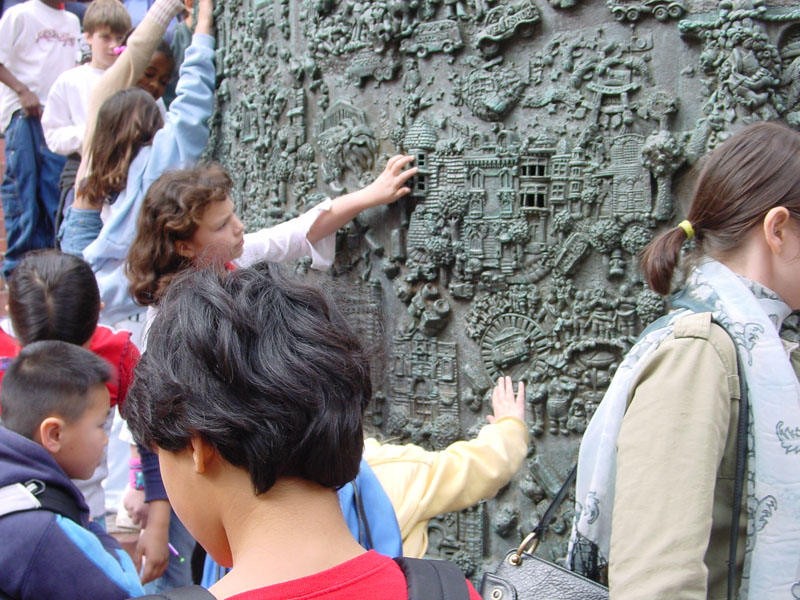
Ruth’s Grand Hyatt Fountain in Union Square. Ruth worked with her friends and hundreds of school children to create the baker’s clay mural that was cast in bronze for this public fountain.

She transformed the ordinary by using readily found materials to make art.  Paper, wire, even the simple ingredients of flour, salt and water could be used to build community. 

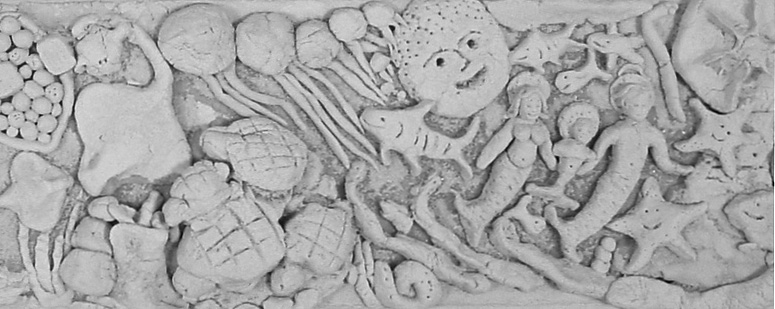
2004 Rooftop Family Art Night collaborative baker’s clay mural.

Rooftop School has benefitted from Ruth Asawa’s commitment to arts education for all children, as well as the extraordinary leadership of Ruth’s daughter, Aiko Cuneo, who founded the Rooftop Art Program in 1981.

With ArtsEd4All, we continue to build upon the Rooftop “family” tradition of hands-on learning, sharing and community building through  arts engagement.

Download a pdf booklet:
Transforming the Ordinary – Ruth Asawa
Student work inspired by Ruth Asawa
Rooftop Alternative K-8 School
Julia Morgan Program Spring 2004