at the Luggage Store Annex / Tenderloin National Forest
509 Ellis Street (between Hyde & Leavenworth)
Luggage Store Co-Artistic Directors/Artists Darryl Smith and Laurie Lazer of the luggage store have been working to transform Cohen Alley since 1989 from a place emblazed in a health-hazardous cesspool of bodily fluids and other dumped items, non-supervised open-air chemical experiments and illicit – criminal activities — to a vibrant community commons where people of all ages can gather for public art, performance, experimental art projects. and classes and activities. In May of 2009, the land that was then called Cohen Alley was reclaimed as “The Tenderloin National Forest.”
“Ode to Mama Tender”— “In 1989, Darryl Smith planted a redwood tree in the shady asphalt. Help us to write a poem as lovely as Mama Tender, the redwood that is the “heartwood” of the Tenderloin National Forest.
“A Tree Grows in Cohen Alley” – Visitors to the Tenderloin National Forest will enjoy a wide range of trees and plant life. Citizen scientists can help to document the biodiversity in the Tenderloin National Forest with iNaturalist. Share your photographs of the nature that you discover in the TNF via Facebook, Twitter, and Instagram. #TNFTenderland
“Wood U Like 2 Play” — Let’s make beautiful music together! Enjoy a wood song sing-a-long.
“Common Scents”– The sense of smell is closely linked with memory, probably more so than any of our other senses. Take a deep breath and enjoy the smell of redwood. Make a scent diffuser to bring home.
The film’s creative team will share how the Kung Fu Panda 3 artists researched China’s culture (architecture, food, clothing, and, of course, kung fu!) for the film. The artists were also inspired by China’s natural beauty, the country’s distinct landscapes and wildlife — including the endangered golden monkey, South China tiger, red panda, and Giant panda. We’ll get a peek at scenes from the new movie, enjoy a drawing demonstration and Q&A with the filmmakers.
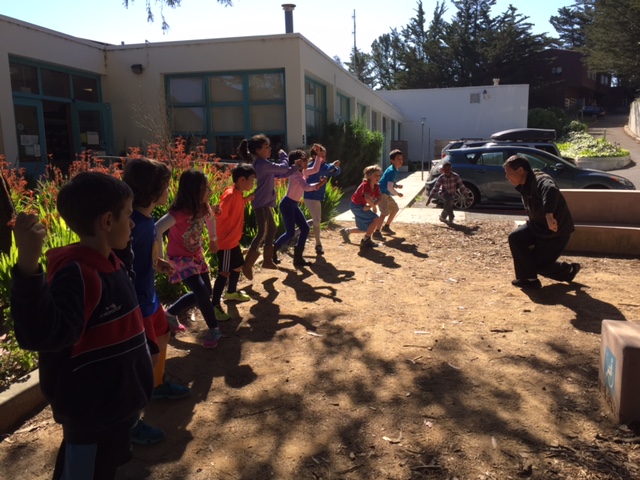
Weather permitting, the entire school is invited to come to the circle for a post-presentation performance which will include a Shaolin animal-style kung fu demonstration with special guests.
There will also be an art activity available for all classes to make their own bolang gu, a Chinese rattle drum, one of the earliest toys dating back to the Song Dynasty (960-1279). Practice playing your drum with friends and use your power to speak up for Giant Pandas.
DreamWorks Animation invited artists, photographers, designers and illustrators worldwide to create art that illustrated Po on his journey home for Kung Fu Panda 3. Inspired by Po, his friends and all the amazing places around the world, artists went straight to work and submitted over 400 stunning submissions of Po in different continents. Whether he was fighting bulls in Spain, trying on some lederhosen in Munich, riding the train in New York, or even attending a festival in India, Po popped up in almost every landmark around the world.
The foundation of the Southern Shaolin martial art systems can be attributed to these five animals – Snake, Tiger, Leopard and Crane, and the mythological Dragon.
Part of the kung fu student’s training is to emulate the spirit and the movement of these animals. They are instructed to visit the city zoo and the library to study the quintessence nature of the animal.
Sifu Young Wong of the EY Lee Kung Fu School teaches third graders some animal style kung fu.
Nature Works Everywhere: Virtual Field Trip to China’s Great Forests
Join expert scientist Yue Wang, a conservation planning officer for The Nature Conservancy, on a virtual field trip across the world to two stunning provinces in China—Sichuan and Yunnan. Explore majestic forests, towering mountains, and other iconic landscapes. While examining the role these vital natural areas play in the carbon cycle and climate change, as well as the benefits of reforestation, we will learn about the magnificent creatures who call these habitats home: giant pandas, golden snub-nosed monkeys, and the elusive and odd-looking takin.
Aware of the need for a strong symbol that would overcome all language barriers, founders of the World Wildlife Fund chose the Giant Panda. “We wanted an animal that is beautiful, is endangered, and one loved by many people in the world for its appealing qualities.” The black-and-white panda has since come to stand as a symbol for the conservation movement as a whole.
Following up on the October 8th Bread & Puppet cantastoria workshop for San Francisco Unified School District, Clare Dolan kindly shares the following examples of International and American Cantastoria. Clare is the co-creator and festival curator for Banners & Cranks, an annual festival of cantastoria performance by artists and musicians from all over the United States, and the Chief Operating Philosopher of the fascinating Museum of Every Day Life in Glover, Vermont, whose goal is to explore, analyze and celebrate everyday life objects.
Contemporary International Cantastoria
Jhadpur Cantastoria
Sicilian Catastoria
Papel Machete
French Cantastoria
Documentary about the Belgali scroll painting singers
Bengali performers performing
Contemporary American Cantastoria
Takes After His Father – by Dave Buchen
As I Walked Out One Evening – by More of Everything Theater Company
Old Reliable Amusements – by The Dolly Wagglers
Bread & Puppet’s The Foot (narrated by Andrea diFrancesco)
Where’s My f-ing Bailout — by Clare Dolan/Museum of Every Day Life
St James Infirmary – by Blair Thomas
Happy Narouz – by Great Small Works
Hurricaine Manifesto – Clare Dolan/Museum of Every Day Life
Answers to 4 Questions – Clare Dolan/Museum of Every Day Life
Ballad of Jacob Apfelboek – Clare Dolan/Museum of Every Day Life
“Our glorious civilization glorifies itself with what it calls high art. Puppeteers have no soul-searching trouble in that respect. What we produce has no ambition to be high art. Low art is what we make and what we want. Not the Fine Arts—the Coarse Arts are what we use.”
— Peter Schumann, lecture to art student at SUNY Purchase, 1987
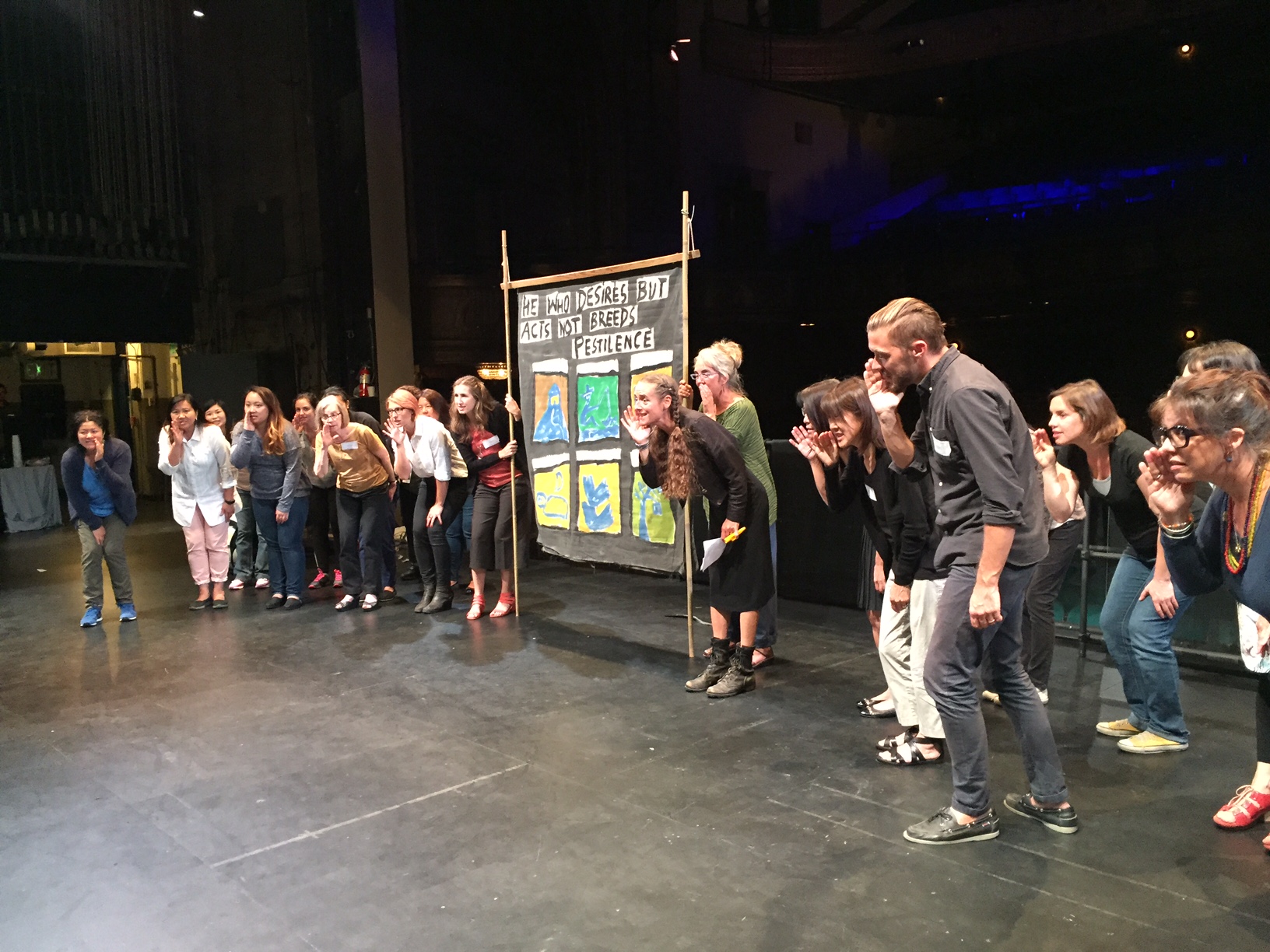
The workshop participants were welcomed to The Curran: Under Construction by Carole Shorenstein Hays, Greg Backstrom and Brian Farley. Andi Wong of Rooftop Alternative School spoke on the theme of “Inspiration,” having received a healthy dose of wonder at the Bread and Puppet Farm in Glover, Vermont, in advance of the troupe’s Bay Area visit. SFUSD Arts Education Master PlanImplementation Manager Antigone Trimis drew connections to student learning, school site culture and climate. After an introductory slide show about Bread and Puppet Theater and cantastoria by Clare Dolan, the art coordinators gathered on the stage of the historic theater to learn by doing.
Cantastoria is one of the oldest performance forms known to humans, originating in India more than two thousand years ago. It typically involved one or two performers, often performing on the street, and a multi-image scroll or a series of paintings mounted together at the top. Bread & Puppet Theater’s version of Cantastoria is usually performed with a narrator who points at the pictures and one or two “choruses” who respond to the narration. The subject of the cantastoria can be anything and directed to any age audience.
Clare Dolan and Bread and Puppet performers Esteli Kitchen, Joshua Krugman,Kali Therrien, Luis Gabriel Sanabria, MJ Hicks, and Tom Cunningham guided participants through the creation, narration and choral performing of this ancient art form.
Bread and Puppet Theater & Cantastoria / Common Core Connections
• Ensemble • Risk • Improvisation • Visual Literacy • Inquiry (necessary for the ensemble to create the piece, will bring added empathy for subject being presented) • Oral Presentation • Close Reading (visual and physical movement, etc, what is the ‘text’ in this work? For the performer? For the audience?) • Student Voice (primary in this work)
For additional information about Bread and Puppet Theater and Cantastoria:
• The Internet Archive “Bread and Puppet Archive” is preserving 150 hours of video of circuses, pageants, passion plays, 250 puppeteers, and making it available to the public. https://archive.org/details/breadandpuppet
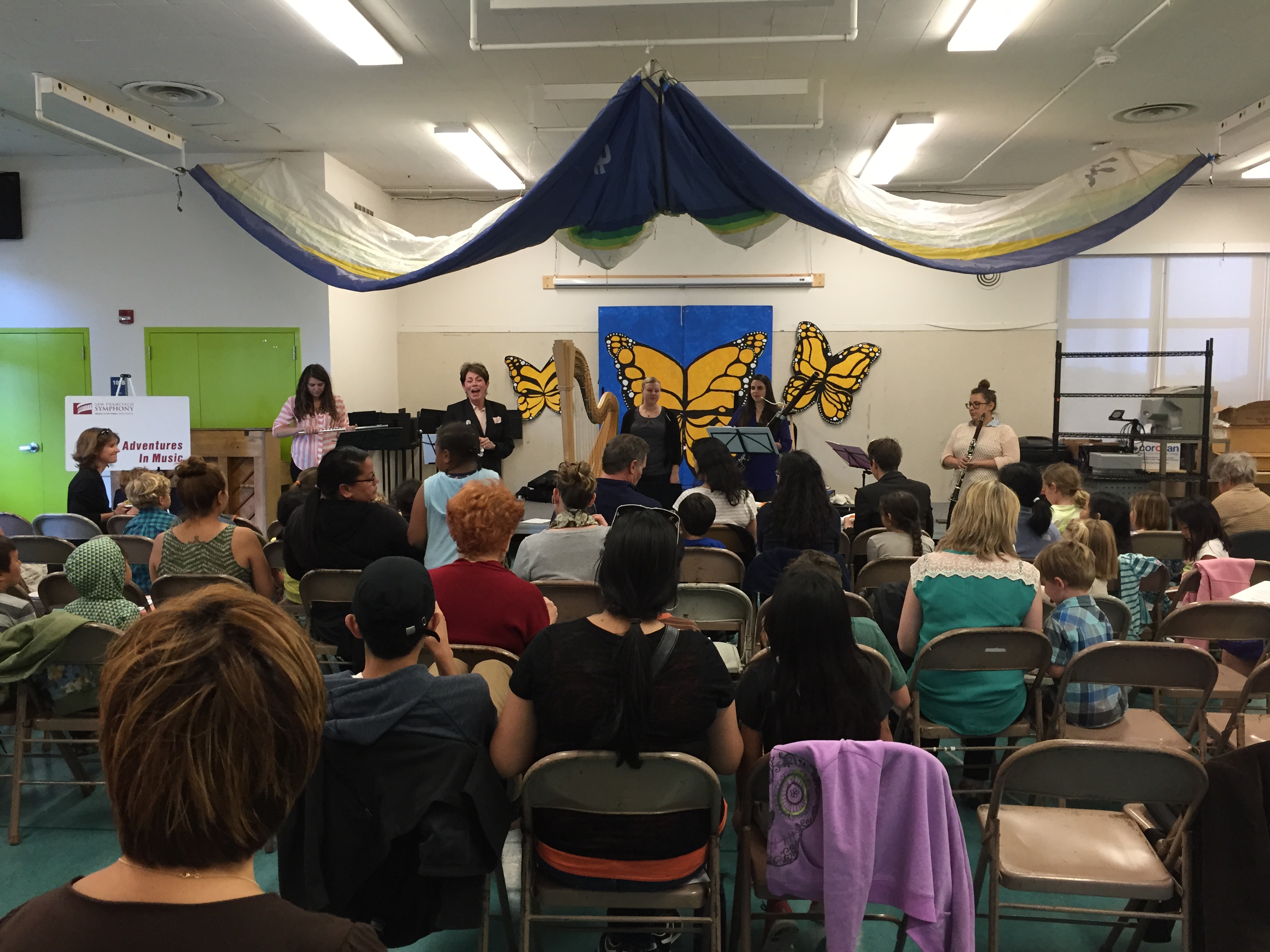
ARTSED4ALL’s project “THE HUMMINGBIRD EFFECT” officially kicked off on Thursday, April 16th with a special Family Art Night performance sponsored by the San Francisco Symphony’s Adventures in Music program. “AIM in the Evening” is a program established by the San Francisco Symphony to allow parents and the greater school community to share the educational performances that the students experience during the day. Family were invited to enjoy a musical performance by Coastal Winds, a quintet of five instruments: flute, clarinet, bassoon, French horn and harp. This 45-minute program demonstrated the idea of musical storytelling to through an original fairy tale: “The Princess of Rhyme.” Harpist Meredith Clark delighted the audience, in her role as the Princess whose voice is stolen by the evil wizard.
A light fairy tale-inspired supper, featuring Mary Poppins’ Practically Perfect Tea Sandwiches, Peter Rabbit’s Mixed Greens Salad with Cranberries and Sunflower Seeds, Geppetto’s Tortellini and Alice’s “Eat Me” Cake, was prepared by chefs Megan Wong and Patrick Wu.
After the performance, families were invited to leave poems for the Princess of Rhyme in the newly constructed Fairy Village, created by students with the support of retired Rooftop Kindergarten teacher Mary Ann Cruz. Children are invited to leave nest-building materials such as yarn and tiny twigs for the birds in the tiny fairy homes. Families were also introduced to the focal species of birds that reside in Twin Peaks: the American Crow, the American Robin, the house finch, the house sparrow, the mourning dove, the peregrine falcon and the rock pigeon.
This slideshow requires JavaScript.
In Technology class with instructor Andi Wong, Rooftop’s 3rd and 4th graders have been working together to establish a bird-friendly habitat in an area known as the “Mini-Garden,” thanks to a mini-grant from “Celebrate Urban Birds,” a program of The Cornell Lab of Ornithology. This new outdoor lab, poetically dubbed “Mountain Eye” by 3rd grader Cameron Budetti, gives students a place of their own where they can learn how to innovate with Nature, the greatest designer of all. Students are free to discover personal interests, as they collaborate with classmates, exploring the ways that technology can be used to transform ideas into real world action.
Students held a ribbon cutting ceremony to officially open the Waterfall Trading Company & Apple Tree Trading Company pop-up shops, student-led efforts to engage community recycling and repurposing. Families enjoyed the magical view from Raven’s Lookout, and the musical sound of conversation and laughter filled the air. The evening ended happily ever after, as the children of Rooftop School helped The Princess of Rhyme to find her voice once again.
If you see a fairy ring In a field of grass, Very lightly step around, Tiptoe as you pass; Last night fairies frolicked there, And they’re sleeping somewhere near.
If you see a tiny fay Lying fast asleep, Shut your eyes and run away, Do not stay or peep; And be sure you never tell, Or you’ll break a fairy spell.
Last November 2013, the students of Rooftop School received a very special present from Flo — their own art show. Rooftop Art’s “A Slice of Life”at the Luggage Store Annex was a companion show to Flo’s 75th birthday show, “The Whole Pie.” As a nod to Flo’s interest in poetry, visitors were invited to stroll through the Tenderloin National Forest to read poems written by Ms. Woo’s 4th graders.
This year, as Flo celebrated her 76th birthday with family in New York, Flo revealed that she was working on a new project with her granddaughter Sasha. As a visiting artist in Sasha’s classroom, Flo used visual art to help children to see the poetry in trees. At home, Flo and Sasha worked together to make a very special tree box.
FLO: My tree project with Sasha started when I was home in Sunnyvale. I took pictures of these trees when I was going on daily walks. I sent them to Sasha after she asked to see the tree trunks I was talking about. My husband Ed knew about my tree-sharing and he began to point out trees to me. There was one, in particular, which inspired me to write my poem, Tree Trunk.
Fast forward to mid-October when I taught a tree-drawing lesson in her 3rd grade class. The day before the other lesson her teacher selected, Sasha gave me input. She told me she didn’t want me to repeat what I had taught in her 2nd grade class.
Flo suggested that the class learn how to draw trees, a spontaneous decision that met with Sasha’s approval. Flo discussed trees, focusing mainly on color of trunks. After demonstrating how to draw a tree Flo told the 3rd graders they could draw either realistic or fantasy trees. The criteria? They had to fill their paper top to bottom, side to side. She introduced them to non-dominant hand drawing and requested one tree be drawn with their non-dominant hand. Then, the students needed to create interest in the negative spaces. They also wrote tree stories. One boy, a ballet dancer at the Met, drew a dancing tree. A girl created one with swirling energy in the trees and the surrounding environment. The hour lesson turned the students into vibrant and energetic tree detectives.
When the class was through, Sasha conducted an exit interview with her grandmother about the lesson. Sasha’s critique: She would have cut back the drawing time so more artists could share their work with her grandmother.
FLO: What I liked so much about the lesson was this – I integrated my love of poetry and art for this eye-opening, heartwarming classroom experience. In the evening at home Sasha and I memorized Joyce Kilmer’s poem. We recited it around the dinner table.
Sasha memorizes Joyce Kilmer’s poem Trees, just as her grandmother had done when she was a young student at Lincoln School in Oakland Chinatown. Flo learned and recited Trees for a tree planting ceremony. She recalled, “We buried a time box with the tree. I wonder if our box has been uncovered. I have remembered Trees for over 60 years.” Sasha and Flo also listened to Louis Armstrong and Paul Robeson sing their musical settings of Kilmer’s poem.
This slideshow requires JavaScript.
Trees drawn by Ms. Robin Farrell’s 3rd grade class at Hillside Elementary School (Art by Andreas, Andrei, Aynsley, Bianca, Bruno, Clara, Dominick, Erin, Graham, Hamilton, Joshua, Leo, Luke, Max, Mia, Michaela, Nathaniel, Paul, Salett, Sasha, Yogev & Zev)
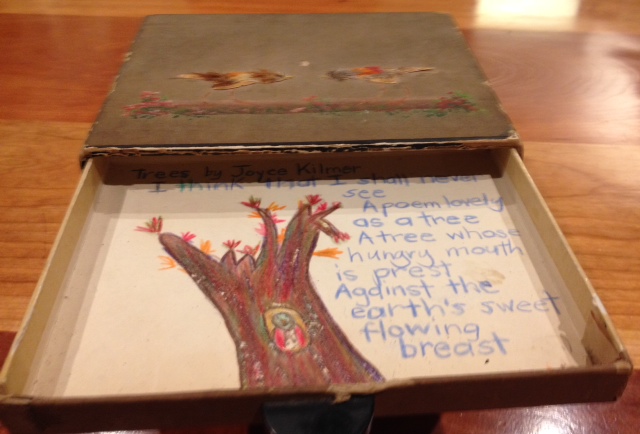
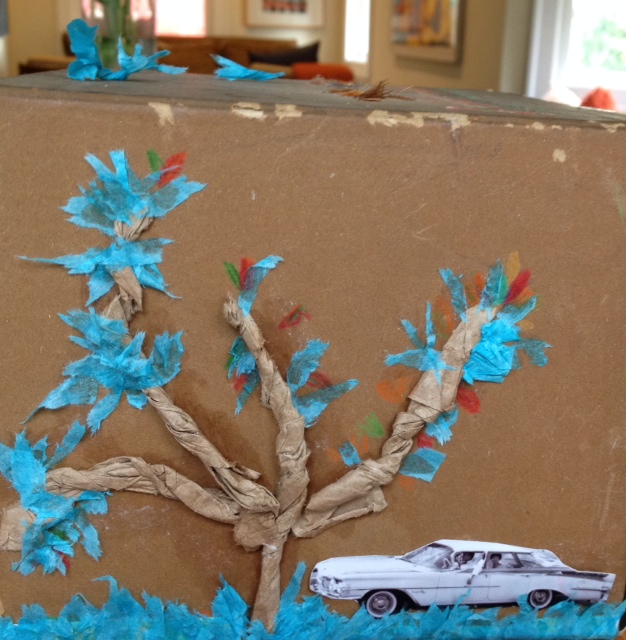
Flo and Sasha’s TREE BOX
When Sasha and Flo find a 1930s box at the local antique store, they decided to make a box tree art project. Sasha includes Joyce Kilmer’s poem (partial) and her Paw Paw’s poem. Flo adds some color atop of the colored pencils Sasha used to render the tree.
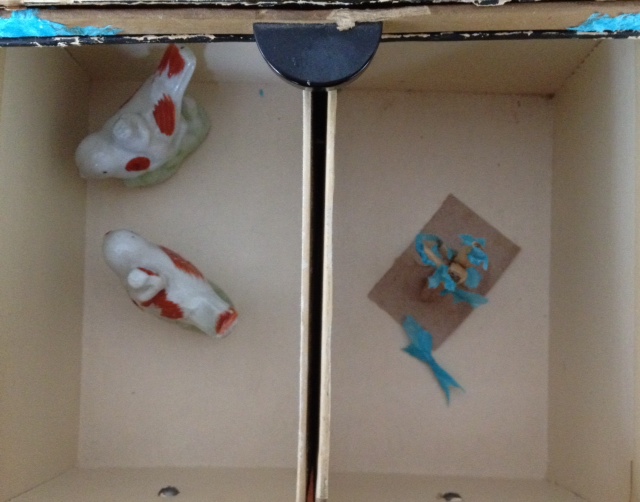
Sasha includes two blue porcelain miniature birds that she has purchased from the antique store.
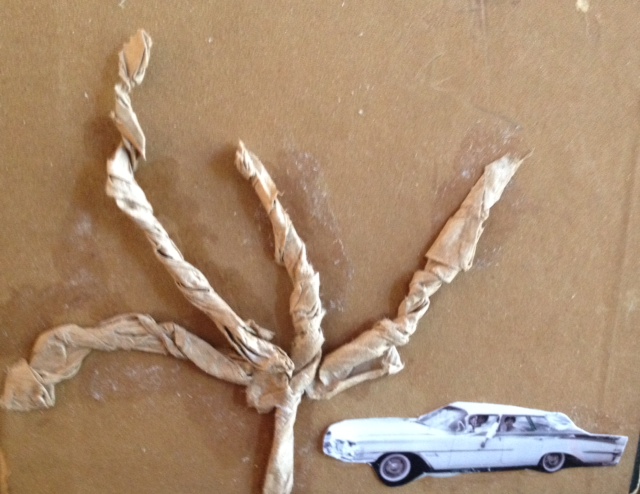
Sasha makes a tree out of a paper bag fragment to add to the tree box.
As a surprise, Flo adds a bird to the lower right front of the box, while Sasha is away at school.
When the box is finished, grandmother and granddaughter take some time to reflect on the process of making The Tree Box together. Flo and Sasha use Flo’s iPhone to record their shared memory of three and a half weeks of bonding and intergenerational learning.
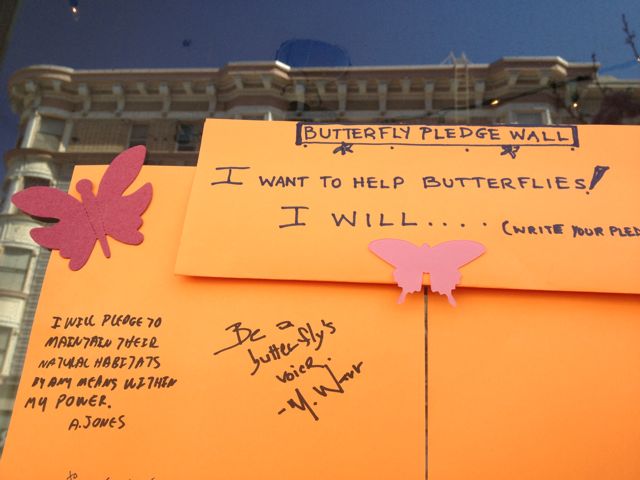
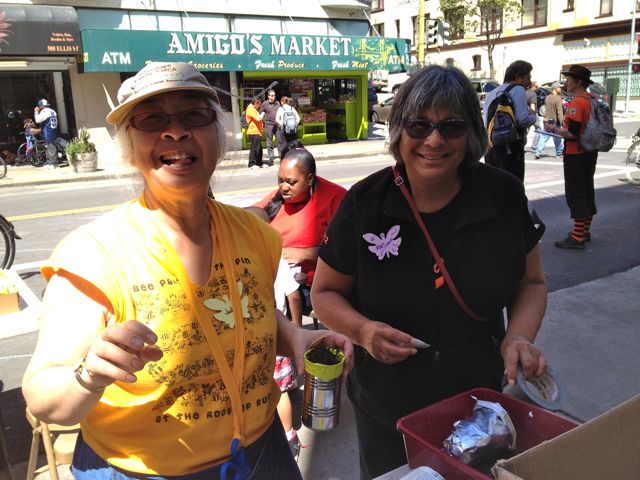
On Sunday, April 13, The Luggage Store Annex and ArtsEd4All partnered to bring The Butterfly Effect to Sunday Streets in the Tenderloin. In support of Makeway for Monarch’s “Call for Contemplation and Action for Monarchs and Other Imperiled Pollinators” marking the 50th Anniversary of the passing of author Rachel Carson. Visitors to the stretch of Ellis Street between Hyde and Leavenworth were invited to learn more about the plight of the monarch butterfly.
The day began on the street readings, Butterfly Poems & Stories delivered by Norma Rodriguez, Mark Heinrich, Joanie Juster, and Christine Dodds, while inside the Tenderloin National Forest, Amara Tabor Smith ladled out helping of her delicious stew with “Fresh from the Oven.”
“Got Milkweed?” Judy Toupin invited passersby to try their hand at planting. Milkweed plants were on display, and The Pollinator Project provided information about how to create pollinator gardens and raised awareness for the protection of butterflies, and their habitats and migratory paths.
Young readers were invited to learn more with the Little Free Library #9859, which was filled with books about caterpillars, butterflies and other pollinators, along with a special contribution of specially selected titles donated by Chronicle Books.
“Butterfly Wings,” a special photo booth created by Rooftop School art coordinators Amy Balsbaugh and Cheryl Ball, with help from the students in Ms. Duff’s first grade class, invited passersby to transform themselves into beautiful monarch butterflies.
This slideshow requires JavaScript.
Crowds gathered in the street to enjoy special musical performances by Rooftop’s rock bands Blade and C&R directed by Mike Rao of The Blue Bear School of Music. The street entertainment culminated with Mark Heinrich’s dramatic reading of Ray Bradbury’s science fiction classic, “The Sound of Thunder,” a cautionary tale involving time travel, dinosaurs and a lone butterfly.
Blue Marbles were given in gratitude to all who pledged to use their voice to help protect the monarch butterfly for future generations. The Butterfly Effect posits that the flap of a butterfly’s wings can set great winds of change in motion, so it was only fitting that as Sunday Streets drew to a close, Lucia of Michoacán should appear on Ellis Street to share childhood memories of forests, dense with the wondrous fluttering of orange and black.
ArtsEd4All “The Butterfly Effect” at Sunday Streets Team
Event Coordination: Darryl Smith, Luggage Store Gallery & Andi Wong, ArtsEd4All
Event Activities: Mary Ann Cruz, Judy Toupin
Photo Booth: Rooftop K-8 Art Coordinators Amy Balsbaugh & Cheryl Ball, Ms. Andrea Duff’s first grade class
Live Performance: Amara Tabor Smith “Fresh From the Oven”
Rooftop Rock Bands Blade and C&R; Mike Rao, director, Blue Bear School of Music
Readings: Chrissy Dodds, Joanie Juster, Mark Heinrich, Norma Rodriguez
Volunteer Support: Academy of Art University School of Interior Architecture & Design, Rooftop K-8 alumni parents Victor Yan, Wendy Hanamura, Sheila Hall
Community Partners: The Pollinator Project, Chronicle Books
For more information and ways that you can help the monarch butterfly, please visit:
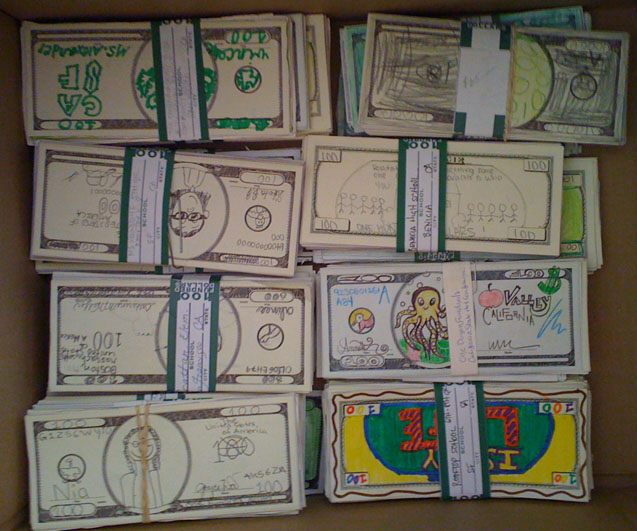
Artist Mel Chin’s The Fundred Dollar Bill Projectinvites children to create their own Fundred dollar bill to symbolically raise $300,000,000, the estimated cost to treat New Orleans soil to create a lead-safe New Orleans. In New Orleans alone 86,000 properties are estimated to have unsafe levels of lead in the soil. At least 30% of the inner city childhood population is affected from lead-poisoning. Operation Paydirt provides the science to transform lead so that it is no longer harmful and a citywide implementation strategy with the potential of creating a model for all cities facing a similar threat. http://fundred.org/
You are invited to contribute your own original Fundred to the project. Start by downloading the Fundred template, and get creative! http://fundred.org/get-involved/
Preparing for the Second Line
The Second Line parade is a New Orleans tradition that arose out of the two parts of a jazz funeral. The second line is a celebration of the life of the deceased, typically held by Social (Aide) & Pleasure Club of the neighborhood. Once a funeral service was over, a procession would travel from the church to the cemetery. Led by a “Grand Marshal,” a brass band would play slow sad music representing the struggles, the hardships, the ups and downs of life. On the way back after the burial, the music would become more joyful. A Main Line is the “main section or the members of the actual club, that has the permit to parade. The “second line” refers to the group of people following the “main line.”
In the “Crescent City,” there are dozens of different second line parades put on throughout the year, held in neighborhoods all across the city. Each second parade has its own style and character, but there are the basics: a brass band, jubilant dancing in the street and people all decked out in colorful attire: sashes, hats and bonnets, parasols and banners.
“Oh Lord, I want to be in that number when the Saints go marching in…”
The Mask, The Umbrella & The Song
Ms. Sugawara’s 7th graders made masks featuring a symbol designed by each student to represent their family’s cultural heritage. The teachers decorated second line umbrellas for their classrooms. Louis Armstrong recorded “When the Saints Go Marching In” in 1938, and the song has remained a tried and true staple of American Music since then. There are close to 1,000 different recordings of the song by artists as varied as Bruce Springsteen, Ray Charles, The Preservation Hall Jazz Band, James Brown, and even the Beatles, whose version was on the “B” side of the their first commercial release in 1961. But it’s Satchmo’s version that people turn to capture that familiar New Orleans Spirit.











 ArtsEd4All